
Franche-Comté – Burgundy | 15 June – 7 July 1946
June 15 – long-awaited date. I have three weeks of camping-canoeing and fishing ahead of me with my old teammate Jean Blier...
The car gobbles up our luggage and, in early Paris, we drive towards the Gare de Lyon. There is a long way from the cup to the lips, Place de la Bastille, we have to stop to change a flat tire. This under the astonishingly interested eye of a person with idiotic reflections (it is remarkable to note how stupid the reasoning of any spectator seems to you when you put a wheel back on a car when you know you have a train to catch). Fortunately we are early and have our seats reserved.
Without any other hitch we arrive at the station where my father accompanies us to our carriage. We packed, without too much difficulty, our voluminous luggage and having said goodbye to Papa we waited for the Departure.


8:05 a.m.! We're leaving! Horrors of the industrial suburbs. Ugliness of the residential suburbs. Only after that, simple beauty of the countryside.
We cross the Forest of Fontainebleau which reminds us of the vision of a recent camp that we made there. Then here is Morêt. Another wandering, in memory, not long ago, yet it was the First One.
Our train is moving at a good pace. A pleasant journey where conversation does not languish, fuelled by our projects, our hopes, our questions...
The axles of the carriage sing, always to the same rhythm: les-va-canc's-les-va-canc's-les-va-canc's-...
12:35 p.m. – Dijon, change of train. There was a little anxiety at the sight of the only two railcars where the SNCF, optimistic to the point of unconsciousness, hoped to cram in a crowd that was unfortunately large and, above all, abundantly crowded with suitcases and various parcels.
Fierce fight, clenched jaws! Cree! Calls! Howling! Claims! Teeth in legs! Elbow games! Savagery...
We find ourselves inside with one of our two water bottles missing, but we are there which is not so bad considering those who remain on the platform.


And then it's the long-awaited finish in Besançon where the "Kingfisher" has been waiting for us for a few days. After a few formalities we take possession of it and, tying our equipment to it, we go down to the town where we can make out the Doubs, over there, in the background. After a few short errands we arrive at the river. First contact! Quite engaging, well, were it not for the color of the water exaggerated yellowed by the flood. Water does not run: it gallops...
Despite the omens of death with which we are gratified by the spectators who seem quite stunned to see us take on water in such a flood, we embark immediately which means that we will know practically nothing about the City of Besançon which seems pretty as far as I see it: the Flying Gate, the Rue Battant, the Rue du Petit Battant, the Pont Battant.
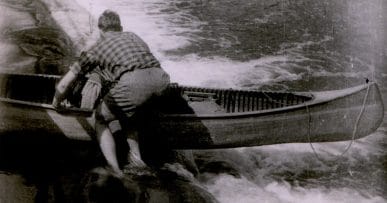
After a few hundred meters we land to empty the canoe which, dried out for a long time, tends to turn into a floating bathtub. Then it's the first dam! Terribly impressed by the fluttering of the rapid, which I see after the ridge line, I recommend a portage or a rope pass. One and then the other proving impossible, we carted after a laborious exit from the water along an 80 cm high vertical wall.
After about two hundred meters, we take the Doubs again, which rolls between hills that despite our enthusiasm we dare not call mountains.
Soon we see a formidable foam, the powdering of which announces a second dam that rumbles like the sea in the surf, but with an uninterrupted sonority of the most impressive for the poor strugglers that we are. At the base of the difference in altitude there is a hollow of no inconsiderable importance and, with limp legs, I imagine myself struggling in the middle of these whirlpools (Teller-Saug und Stosswirbel by Joseph Kroener, Chenu dixit). Once again, carts.
We pass between landscapes that man seems to have made a point of trying to dodge with his houses and factories, but it is still only the suburbs of Besançon in short, and from Beurre, the landscape is purified.
Jean and I discuss at length the height of these peninsulas.
We will camp right against the Doubs which roars a little downstream on the Gouillé dam.


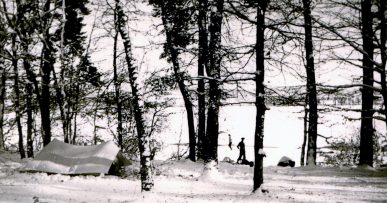
The tent erected, we inaugurated a new mosquito net and we also tried this first evening a new way of sleeping which would give me complete satisfaction provided that I shrank by about twenty centimeters, the tips of my legs looking clearly embarrassing.
Soon there is silence and sleep under Pascaline.
June 16 – As soon as lunch is over, we will carry out an in-depth reconnaissance of the Gouillé Dam, which we barely saw last night. It's still too big a chunk for us, I decided; at its foot a threatening eddy is hollowed out. Downstream, the water, indignant at the hindrance that man imposes on it, manifests its anger in multiple waves and countercurrents. To think that yesterday, I had judged "this" to be crossable! It is true that the river having descended, the difference in level must be more pronounced than yesterday. I capitulate once again. Even going to the rope would be difficult with the speed of the current, maybe even impossible.
We will therefore advise, but first, we will feel the river as fishermen. Jean rides a feather line and I a Buldo, and in the middle of the reeds that garnish the river at the tail of a small island we attack the maggot.
As is often the case, Jean outclasses me in numbers. He even takes a rather beautiful roach, as for me I dodge the empty-handed with a few bleaks and spirlins.
But as on the whole it doesn't bite much anymore, we leave this pretty corner and head towards the dam by the left arm which inspires me as much mistrust as the other. We carry on the sack weir. (Dry? This is a way of speaking because at that moment a storm breaks out and rain and hail are generously distributed to us). Jean's pilgrim and my anorak are gratefully debuted.
The supplies from Besançon having been consumed, we set out to find some vegetables. We will only find it in Avannes after a few fruitless steps under a rain that a properly blocked sky promises us to persist. But apart from rare vegetables, nothing to find here, confirms a guy busy gobbling up a whole Camembert from his box...
The Avannes dam forms a vast "V", but despite this omen... Victorious, I deflate (once again!) and despite Jean's exhortations and his regrets, we drive through Avannes where a half-submerged washhouse offers us a reduced refuge from the rain that has just stopped but which strongly threatens to "do it again". Here at least, if we have hardly any room, we and our Kingfisher are safe. Supplied with wood by water (Jean having stayed in the boat to provide me with some and not to bother me) I quickly made a pot that smells fragrant.

It's good to eat something warm after getting wet, because while our raincoats consciously protect our shoulders and upper body, they leave it to the bottom of our anatomies to protect themselves from the rain, so my shorts are copiously soaked.
During our lunch in the shelter the rain had stopped, now that we leave the roof of our washhouse, it starts again! Thank you Saint Médard!
After a few minutes of sailing on an increasingly muddy and overflowing Doubs, Jean asks me "for the sake of form", "we haven't forgotten our rods, at least". I utter an oath which, although not elegant, nevertheless conveys my anguish very well. Indeed, as our ready-made canes were in the way of us at mealtime, I had placed them in a corner, under the roof of the washhouse where they remained... if "the world is honest" (Maurice-Constantin Weyer, dixit).
As the current is too fast to be climbed, I will go on foot: barely 1 or 2 km.
Taking advantage of a clearing I go to repeat to myself that I have always been lucky and that I must find the rods. Pretend to be a fisherman and forget your rods! Not even a fish...
I arrive in Avannes under the rain which falls again as we see it fall, too straight and too abundant, in the scenes shot indoors in the studios of the cinema.
How to reach the washhouse, isolated like an island in the flooded water? Is this boat inaccessible? Thank heaven his chain is not padlocked...
For the sake of form, I ask spectators who look with astonishment and curiosity at the hay that is walking under such a deluge from a covered balcony:
"Can I take the boat? For... »
The rest of the sentence is a vague stammer because I don't have time to waste explaining my whole story to them. They have only understood one thing: I want to use the boat and their broad gestures probably mean "not ours, can't know". There is no worse deaf person than the one who does not want to hear, so leaping into the boat I shout in the rain a big "Thank you, M'sieu-dames" and unchaining my ship on the way to the washhouse! Never mind the decalitres of water that at the bottom of the boat bathe my soaked feet, I just saw our rods! To take them, to plunge back into my bathtub, to get back to the shore, to jump into them (in the nettles), to reattach the chain: it is a matter of a moment. And I go to find Jean.
Avannes, nestled at the foot of its hills and topped by a rainbow, is a jewel and its bell tower, which, like all those in the country, resembles those of Tyrol, is a rustic wonder.
Now the sky is cleared and it is in sunny weather that we go, gliding on the meanders of the Doubs which retraces its steps and cannot bring itself to abandon the site of Avannes.
All of a sudden our hearts beat faster: our first rapid is offered to us.
It seems very respectable to me and must be about 100 meters long. Without having time to put away our rods still all deployed, we approach it...

It dances hard and I paddle hard with a little delicious anguish in my heart. Apart from a few splashes that make the charm of the thing, everything goes without incident.
After this interlude, a second rapid is announced but before approaching it we will stop to refuel in Rancennay. It's a cute village perched on the hillside where I find a few potatoes and a piece of bread not without difficulty because there is no baker here.
I join Jean and after a reconnaissance of the second fast which is more modest than the first, we leave and move to the far right.
We are approaching the place where we are going to leave the Doubs to join the Loue and suddenly a fear invades me: the road that I saw on our left as we crossed the first rapid was not the one to take? After examining the map, our mistake was confirmed: we had passed the N83. Fortunately, a little further downstream, we still have a path whose meanders also end in the Loue. We soon get there and a small tributary helps us get the Kingfisher out of the water.
After serious efforts we are on the road with our wooden friend on his cart, and as we attack the first side the rain starts to fall again. What a sweat we're going to sweat under our raincoats!
Little by little we go up and it turns out to be less hard than I feared. On the other hand, Jean pushes less and less energetically: the poor old man is tired, he blows his nose and sniffs everything he can and as we have soaked feet he fears a flu or at least a "homemade" bullfight. So that he recovers a little, I continue alone the carriage of the Kingfisher while he follows me, grumbling more or less about the uselessness of continuing any further. But I, who have had in mind for two days to camp on a hill from which the valley can be discovered, I continue into the night which has now completely fallen.
After a lot of effort I finally arrive at the N83 where the cart becomes less painful. We are quite high up and the fog that rises locates us in the Loue valley. It's a shame that the darkness hides the landscape from us. Can't wait for tomorrow and the day!
Finally, the road starts to go down and it's high time to find a place to camp. Alas, we only see fodder... What to do? We don't want to upset the farmers towards us by damaging their hay, but I'm now almost as exhausted as Jean and we opt for a meadow that seems less dense than the others.

The tent set up in a hurry.
A quick cold dinner.
Snoring.
On the morning of June 17, I am horrified by our cowardice last night. Must we have been tired to go up in the middle of the fodder like this? And at every passer-by on the road I expect a stern admonition. As Jean shares my feeling, we fold quickly and have lunch while carting. What beautiful views of the Loue! After about 3 km we arrive in Chenecey where we will embark because it is impossible to do it before although we have been following the river for several kilometers. How, in fact, can you ride anywhere other than on the roads with these meadows whose slope is so steep? Unless you're a mountaineer...
Before the launch, a tour of the village is necessary because the food is running low. I get us bread, sausage and cheese. The latter is a superb Port Salut, complete, and of a very advantageous price, which augurs favorably for the supply of the country. I would send one, but as there is no post in the country and I hesitate to transport two wheels from Port Salut, I postpone this shipment until later (Such an opportunity will never present itself again: one must not put off until tomorrow what one can do the same day!) .
Having settled in Chenecey for lunch, we only manage to cook our bowl after hours of effort as the wind blows strongly. A pleasant counterpart to the zell: our long-wet belongings quickly dry up clinging to a barrier.
We then leave the area to approach the thresholds of the Loue, one of which was revealed to us this morning already, from the bottom of the valley.
Until now, novices in sport canoeing, the word "threshold" intrigued us. Now we are informed: we pass the first after a long reconnaissance downstream (and a careful scouting: we will pass to the left of... to the right of... Come in... etc.). Finally, we will cross it at random, the view from upstream is totally different from the one from downstream.


First threshold: pleasure, excitement, delicious anguish... A slight tailgating adds to our pride, leaving us to imagine that we have just escaped formidable dangers...
Then modest rapids and amusing thresholds are crossed without a hitch, so that we are in the second stage of learning: after unjustified fear, blind trust in our so-called abilities. So, let's jump, without even recognizing it, a fairly honorable dam for novices, and this by "boarding" copiously: Jean is soaked, I, as a helmsman, am unharmed.
Scooping... Let's go...
Soon it was time to think of the camp and we established ourselves near Chay-Chay, under the ash trees, after our prudence (or our cowardice) chased us out of a corner that would have been ideal if it had not been shared with cattle.
After a comfortable dinner and a short reverie in front of the always beautiful Loue, we return to the tent


On the morning of June 18th, we arrived at Quingey, a pretty little town where the abundance of supplies allowed us to make a small supply of cooking fat, and with that: vegetables, meats, etc. Except fruit. Jean finds here his first letter, nothing for me. Weird! My mother, who is usually so epistolary...
The Quingey dam is not helped to cross, unless you are quite to the right... But on this overcast day (it even rains at times) we don't care about capsizing, so we drive through the city.
After one or two kilometres, we are in Lavans-Quingey village where Jean has an address where he can buy fruit: what a bargain. Recommended by Môssieu, the Postmaster of Quingey, he could only succeed in his mission: he returned with strawberries full of strawberries.
We had lunch in the area, letting ourselves be admired by the farmer who had come with her little girl to show him "the boat of these gentlemen".
"The sweet joy of popularity", as Jean says, who likes to quote Doctor Jaubert.
Departure.
We travel through a charming country but less wild than at the beginning, the hills lower, the valley widens. As for the fishing spots, they are amazing, but here the Loue is, almost everywhere, private property and, on the other hand, a curious phenomenon, under the action of the splendid landscapes we cross, Jean and I feel less fishermen than tourists and hikers, more canoeists than disciples of Saint Peter. So it is without great difficulty that we observe the regulations and that we do not fish in these splendid (but still muddy) waters. Although to the worm...
As we lack water, we make a short stopover after the bridge of X..., baptized by us "Pont Pisseux", because of the dripping that flows from one of its arches. On the left bank, in the village of ... I go to fetch water after a short shower which does not give us much shelter as we are under our raincoats on the one hand and on the other hand under a huge abalone which covers us and our Kingfisher.
As I am near a farm, I go in to ask if there is a way to get some milk. After a short meeting in a wonderfully incomprehensible patois with her male, the woman of the filthy den into which I had entered told me to wait. A few moments later, she hands me my bottle, rewarding me with the most gracious smile that her two or three remaining teeth allow her to address.
Today we jump several dams, including the Belle-Fontaine dam, our highest to date, about 80 cm (but after how much hesitation!)


We will camp this evening on the slope of a hill, in sight of reindeer, where we hoist our equipment, the Kingfisher alone remaining at the bottom, more or less camouflaged in a bush.
What a splendid view we have!
Behind us the sun must set in an apotheosis judging by the rays that make the crest of the hill where we camp out in a magnificent Chinese shadow. Too bad we don't have time to climb up there!
But, fortunately, the view in front of us more than compensates and whether we look to the left where unreal clouds are igniting or to the right where the village of Rennes is basking in the light of the sunset, it is still as beautiful.
And this evening, thanks to the open door, without leaving the tent, I still enjoy this wonderful corner of France for a long time before falling asleep, my eyes still discerning it in "the dark light that falls from the stars".

June 19 – We leave our eagle's nest (I sometimes exaggerate!) to embark around noon.
In Rennes a roadblock stops us: let's go and reconnoitre. After a few moments of reflection, Jean declares him "not convenient". A native shouts to us from the top of the bridge: "There is a bad passage"...
I, who was so cowardly at the first roadblocks, have changed a lot that I declare it: "Not very difficult!" When I think that the nautical guide doesn't advise skipping it! For the others too, he recommended carting and... We jumped. We will pass either in this arm upstream of the grasses, or in the other on the far left!
Galvanized by these words, Jean agrees. For the first time we are moving forward... Too far to the left! Jean shouts to me... U-turn with big paddle strokes and we come back to it further to the right... Too slowly, badly in the middle (quite a helmsman!). A big stone on the losing line... We are hot on our heels... The Kingfisher is lying on the left in a worrying way... I go to the right... The front dives... Dives...
When I come back to the surface, I hear Jean gasping as if at the finish of a marathon. Would he drown? No, because soon I realize that I am doing the same. The explanation: the icy water oppresses us with this unexpected bath.
I caught up with the two paddles which, fortunately, did not drift in the current. Without success we try to get back into the canoe ( Later experience will show us the uselessness of this manoeuvre, a Canadian full of water does not sink but is as unstable as a barrel ), and all of a sudden I feel the bottom.
"We have feet!" I say to Jean, who is splashing around very honorably for a beginner swimmer, especially since we are fully dressed.
Regaining our footing, we stop the Kingfisher which shows some inclination to continue downstream but the foam carpet, on which my teammate was paddling on his knees, goes happily along the water. "We'll have him later," I said optimistically (in reality it was the last vision we had of him).

And to scoop vigorously, some with a saucepan, some with a canvas bucket, while singing the "Gars de la Marine" which may seem like a questionable opportunity.
Fortunately, apart from the foam mat, all the equipment was carefully secured: nothing moved.
Once our canoe is a little empty, we head for the small island after the bridge. We approach it and gymnastics, a little calvados and the work to be done to spread out our belongings to dry them quickly warmed us up. Apart from the Mathurin bag, everything is soaked! Including my Gallus which oozes water and has its lens fogged up.
While our things are drying, under a providential sun, which has just shown itself, I leave for the refueling. Alas, what can you find in a hamlet that has no shopkeepers, not even a baker? However, I manage to gather bread, eggs and matches (ours are disastrously wet).
A hot lunch revives us and while Jean turns the things over to dry them like meat on the grill, I try a few photos with my Gallus which seems dry. Unfortunately, the same is not true of Jean's Kodak Brownie, which seems to have suffered from his dive.
And the evening falls on a team that says to itself, not without pride: "We are no longer beginners, because as Jaubert said (always him!): We must have capsized!" Besides, our morale, which has not weakened, is only strengthened, touched by the grace of Providence which has made us capsize in such a beautiful corner.
Indeed, at dusk the place is magnificent and the old houses that border the Loue bear witness to the fact that the work of the "human parasite" can sometimes be harmonious. Herds are returning to the stable, but one might think that they are walking around only for the pleasure of ringing the bells with the charming sounds that adorn the necks of cows.
We slip into our now dry bags and fall asleep, with the sound of the dam rumbling a few meters from us in our ears.


June 20 – I get up early and, while Jean is still sleeping, I prepare breakfast. Then it's the departure quite early.
Today we are sailing under the sun and it is with a bare chest that I paddle (regrettable imprudence whose effects... but let's not anticipate).
We are focusing on the Belle-Fontaine Dam whose caretaker welcomes us not very civilly. We will see later that the whole country seems to have tense nerves and curse the "foreigners" because of a holiday camp (the Colonie de Mouchard) which did not know how to make itself loved.
At Port-Lesney (pronounced Port-Léné) a fairly abundant mail awaits us. I answer it by writing my letters sitting in the M.P. while my back starts to bake. Holy Phoebus! I had lost the habit of it!
We have lunch in a small paradise of pebbles, willows and very pure water. Only at first would I smear myself with lard and more or less rancid butter. But it's too late to escape the sunburns and the only advantage (?) of my process is to stink cordially.
After a short stop to get water (and what water: not too cloudy but rich in various aninacules) we arrive at the Champagne dam.
Made cautious by our experience in Rennes, we decided to put it on the rope.
Jean, who has been steering for the past 1/4 of an hour, is taking a little too far to the left (after my clumsiness in Rennes, here we are). We are both at the crest of the dam e, a spillway and are holding the M.P which is going too far to the left... fights against a stump. Will we be able to get it to the right? Alas, the stern hump is too short and our poor canoe, deprived of its masters, staggers from port to starboard to finally get across. "This is the end," I said, ashamed to see him capsize so ingloriously Jean, who may not have yet realized the imminence of the shipwreck, says to me, "Be careful, it's filling up!" But how can we prevent him now? Crack! It's capsized...
While my teammate runs downstream where he deftly grabs and attaches the front hump to a branch, I brace myself on the ridge line from where I hold the rear. What tension on the mooring! Twice I almost see myself dragged away.
Jean signaling to me that the front hump is securely attached to a branch, I let go... The M.P pivoted in the current and got stuck crosswise on a large stone. Luckily, the paddles were able to be recovered before going off along the water.
We then begin a laborious unloading of our canoe, the whole load of which soon weighs three times as much, soaked in saturated water: Jean staggers to drag the bags that I have difficulty passing to him.
My boyfriend is not very reassured: "If a bump breaks, you will be swept away by the canoe..." All feverish from my sunburns, I work a bit like a dream, my head heavy and my legs limp.
Finally, everything being on the ground, I stand downstream while Jean cuts the moorings: if the M.P passes out of his reach at that moment, I will jump into the water and have it.
So it's a miracle. Under the action of the current, as soon as the hump is cut, our Canadian gets out of the water, more and more, empties himself and all of a sudden the other mooring line breaks... I am about to jump into the water to catch up with our boat when I see it turning in a whirlpool... and to take his place in a little cove where Jean leaps up and makes himself master of it.
We struggle for another quarter of an hour or so to get our things out of the small muddy arm where they are temporarily piled up and each trip includes a kind of crawling under thorny branches. And with my sunburns on my back!
It is too late to dry our equipment and use it for the night. Ah! If we could only find a barn to sleep in! While Jean twists, wipes, sponges, I cross the Loue in a canoe to negotiate with the miller opposite and find out where to find a roof. The nearest town, Arc-et-Senans (Arc and S'nan, as they say here) is 2 or 3 kilometres away: we have to reach it at all costs, we will find a hotel, a room, a barn... a pig bed...
Rapid piling up in the canoe. Let's go! We land in a feeding arm in the heart of a sawmill. Difficult landing. Cart where I turn out to be tired. Charitably Jean reminds me that there is ...
For a few days, between Doubs and Loue, I was alone when he was fainting. I accept his gratitude with relief, for I have legs of cotton, a head of lead, and my back is nothing but an inferno.
After a lot of difficulties, here is a hotel that offers us food and lodging.
In front of fried eggs, a cheese and a bottle of Arbois we take stock of the shipwreck: if I do well, Jean, less lucky, leaves his waterproof cape, which has gone to join the moss carpet, and his kodak which has gloriously perished in the waters.
At night, troubled by a nightmare in which I would see myself crushed under the wheel of a water-mill, I would utter cries so wild that our two unfortunate neighbors would believe that I had been murdered...
On June 21, a hot and sharp wind blew despite the leaden sky and our business did not dry badly. The morning was spent repairing the shipwreck and running small errands, as well as part of the afternoon. It is only around 4 or 5 p.m. that I ask for the bill. Blow to the heart! There are 780 francs worth of them. And as I was surprised, I was told that the tip was not included and that the Arbois wine was responsible for this astronomical cost.
After the sunburn, the shotgun...
We return to the Loue by talking about this hotel interlude that will mark as much in our memories as in our wallets.
Of course we couldn't leave the Jura without knowing (and appreciating) Arbois wine, but still!
We don't sail for long today, because it's almost time to camp and a lovely spot is offered to us.
While Jean was preparing the home, I went to Cramans where, despite the lack of generosity of the inhabitants, I turned out to be quite a good beggar.
After a good dinner, we return with satisfaction to our canvas shelter following our expensive hotel experience.
My sunburns are better and the little rain that starts will have time to stop during the night.
June 22nd – No, it hasn't stopped and this morning we have an ugly leaden sky that hides the "Mountain" from us (we have named a fairly high mountain after this, m. indicates the map, which we have not stopped seeing for 3 days that the meanders of the Loue have been walking us around it).
I go back to Cramans where I stock up on provisions, having already developed a most touching capsize story that is starting to bear fruit: bread (without tickets: I lost a card), eggs, milk, cheese.
We spend the day cloistered in the tent except for two fishing trips where we take turns to get soaked for meagre results. I take a Vaudoise and a minnow. In a trout river! Misery.
The water rises and soon the low banks are flooded, eaten away by the silty flood. We keep ourselves busy with belottes, snacks, snacks, five o'clocks, breakfasts, lunches, lunches, suppers, etc.
Maybe tomorrow will be fine?
June 23 – Rain again. I returned to Cramans where I began to be known. I put together a family parcel: Gruyère creams and I came back loaded with provisions. I have found oil that will allow us to no longer touch our last reserve of canned goods as we did yesterday and that will allow us to absorb something hot. Alas! What a state our cookware is not in after it is used on a kerosene stove of my own making!
Finally, around 3 p.m.: clearing. We jump, fold the tent, put away the equipment and off we go! We take on water. And what water!
The Loue in flood gallops, yellow and threatening, eating away at its banks which crumble or collapse at times with a rather gloomy "floc". Unleashed, she overturns the obstacles that stand in the way of her mad race. A dam almost erased by the flood impresses us with its hydroelectric turbine flow and its oppressive opacity. We drag the M.P. across an almost submerged island and resume the descent.
The river rushes at 15 or 20 miles an hour, carrying with it a multitude of debris: stumps, bushes, trees, mowed hay and, for the 3rd time in the month, it will surprise the residents with its summer flood that they had not seen for eleven years, it seems.
We hurtle down at full speed under the astonished eye of some spectators who consider us to be suicides.
After about an hour of this speed of a bolide, in which more than once we have seen coming upon us at a disturbing speed, such a stump, such a shore, or such an upstream point of a semi-drowned island, we reach Ounans where, at a bend in the Loue, intimidating waves break as in an arm of the sea.

"Let's quickly fail on the left, we can't pass this..." »
A first manoeuvre failed. Quickly we try a second stranding... Beware of submerged stakes... we brush against them... we passed... the calm water carries us. Get down! Saved!
Jean goes to the post office and in the meantime, getting used to these blades that frightened me so much, I decide to cross them, because here a cart would be painful. When my friend returns, I can't share my project with him and finally, it's by carting that we cross the bridge that spans the river, not without a certain grace despite its modernism.
While Jean is at the aid station, I set up the tent near this little arm. A native dissuades me from doing so, because the Loue would flood us this night at the rate at which it rises, he tells me. I dismantle and reassemble further. After a dinner in the dark, it's sleep.

June 24 – The sky is almost completely clear and a hot sun dries what was still wet in our business. On the wise advice of Jean, we agreed to make a fixed camp for a few days until the flood was calmed down.
We pass near the small arm (tributary more exactly) where we had originally pitched our tent on the days of June 24 and 25. We spent our leisure time fishing (not very fruitful), provisioning (in Ounans, Santans and Viller-Farlay) and cooking. I got a rabbit and a stew that will be an epoch in our holidays.
On the morning of June 26th, we set off again into the sun that will never leave us. John, who considers him his God, triumphs over me, who deified the Water. But now that my peeling back advises me to be careful, I am wary of Phoebus.
We parade in the middle of charming or grandiose landscapes but all terribly fishy and yet we fish so little.
We will soon arrive at the confluence of the Loue with the Cuisance, but on the still large river the flood arms merge with the tributaries. Deceived by this resemblance, we are led astray into a kind of tropical arroyo. Finally, believing that we have found the elusive Cuisance, we camp on the banks of a stream which, we will learn later, is still only an arm of the Loue: the Mortes Grappes.
That evening, we get to know the mosquitoes. Oh!
Odious. Torturers. Infernal. Terrible. Evil. Frightening. Demonic. Wild. Horrible.
No adjective seems to me to be enough to describe these damned critters as they deserve!
It is only through a voluntarily feverish and uninterrupted activity where the arms and legs are constantly in motion that one can escape them, partially, an oh so!
And always they aim (and reach!) the point of the body that is not agitated by epileptic starts: the neck, the ears or the bleeding of the knee. Insectol tube is welcome. Alas, its beneficial action is only momentary and we have to resort to smoke to protect ourselves a little from these sacred diptera!


We are suffocating a little, but our enemies must capitulate. And the wet wood from smoking profusely...
Once the tent is closed by our brave mosquito net (it sounds tropical, exotic, Jean likes to say) we voluptuously murder the imprudent cousins who have ventured under our roof.
Blessed are the effective mosquito nets!
June 27 – In the morning, we forget with relief the mosquitoes invisible at this hour and we break camp.
After a bit of fruitless throwing in the Mortes-Grappes (and yet, what corners!) we resume our descent.
After a jump-off and greeted by the now ritual "Fonsnick... Fonsnick ... Fonsnick ... Yop! A secondary arm tempts us, but we must soon retreat from the mosquitoes which make fishing impractical unless we have a dose of patience or contempt for their bites, which neither of us possesses.
We have lunch on a gravel pit in the sun, where we enjoy the absence of the maddening cousins.
A little Buldo fishing brings us only a few minnows, Vaudoises and tiny chubs.
Jean walks around without success, his spoons are nevertheless irresistible.
Their time coming back with the sun going down, the mosquitoes chase us away from this charming corner that looks like a Loire beach.
In the middle of the current we are out of their reach and paddle with enthusiasm and energy on this water that has become so clear again.
A dam that does not even have the excuse of its beauty forces us to take the M.P. out of the water because jumping it is impossible.
We then arrive at Parcey, the last town on the Loue before its confluence with the Doubs.
While Jean goes to the post office, protecting myself as best I can against the eternal mosquitoes, I renew my supply of worms and turn over a corner of the bank of one square meter with my knife for all tools. This work of Romain provides me with some rickety worms.
Jean back, we pass under the Pont de Parcey and camp in a mowed meadow where the mosquitoes (always them) are so numerous and so belligerent, that they annoy me to the point, remarkably, that I get angry with Jean who was discussing the usefulness of buying a pack of cigarettes (cigarettes = smoke = fleeing mosquitoes). Jean goes to the supply station while, gesticulating like a man possessed to keep the damn critters away, I set up the tent and prepare dinner.
My companion will not return until night with incredible stories to tell me: the Loue-Doubs confluence is nothing but a vast swamp bearing the encouraging name of "Mortes" and where mosquitoes reign supreme, where the mud is treacherous as hell, etc. etc. The local canoeist colleague from whom he has this information will come to visit us this evening, after dinner. He arrives, escorted by a kid with whom I already cut a bib while waiting for Jean. Our new friend also brings a bottle of Morgon to which Jean does great honor (with the laudable aim of preserving our knowledge of a drunken wine already well on the way to being made, he confided to me later).
By the light of our glowing fire, this confrere tells us about his crossings of the Dead.
"If you set foot on land, you're doomed: 8 meters of silt is common. An aspect of an equatorial backwater. I know Chad: it's kif-kif. Mosquitoes bigger and more ferocious than here (where there are already twice as many on the Mortes-Grappes that I named yesterday: the worst place I've ever seen!). On the other hand, a unique adventure to live in France. A prodigious corner. An ancient city lost in the marshes. The prestigious Pays des Goubaux! »
We decide to give it a try, and, our narrator gone, we fall asleep dreaming of landscapes from the primitive era in giant marshes with astonishing reptiles in the middle of a sprawling flora.
June 28 – I go to Parcey to get provisions for this formidable expedition. I come back with the firm conviction that our man of last night is only a boaster with a southern imagination (he is nevertheless Swiss).
The people I spoke to about the Goubaux described them to me as a very feasible and not so terrifying area. The veterinarian from whom, still on the advice of our Swiss, I went to get a mosquito repellent based on cade oil, replied with a discreet smile that the Mortes were hardly more "mosquitoed" than here ( It should be noted that in Parcey, almost all the houses have a mesh door, like a pantry door. That says it all! ).
And in Parcey Soleil, over whom his cute church watches over, I am almost certain that William Tell's compatriot is, if not a liar, at least an imaginative.


I join Jean, and while fishing, we let ourselves drift towards the unknown as soon as we have eaten our quick lunch.
I take out two honest Vaudoises and others smaller ones when the Loue (still a little high and fast) forces us to bring our rods in from the obstacles that arise: stumps and uprooted trees are numerous here.
Soon we are all at work and approach the Goubeaux.
Has our Switzerland been telling the truth? Several arms move away from the main bed. We were advised to always take a left. After a wrong direction we retrace our steps, not without difficulty, and resume what we hope will be the main arm. It is strangled between more and more islands. The current remains very fast and stumps lie in ambush at the water's edge, entire trunks obstruct the road: we are slaloming. To the left, to the right. In the end, we are stuck in a dead end.


At the bottom of this cul-de-sac, the current rushes under a pile of trees that completely block the bed of the river. And for hundreds of meters we see the same spectacle. When we have seen what the Loue in flood could carry, we understand the inextricability of this chaos.
Our Swiss had not lied.
As for the swamps, it is quite possible that by dint of dividing into so many arms the water will lose its current and die in backwaters.
As for mosquitoes, it's only 3 p.m. (resting time, then) and what an activity!
And we have to turn back.
This requires considerable effort to go up this terrible current. We achieve this by clinging to the banks where the paddle is no longer fast enough. Jean enters the water up to the middle of the body to drag us through the tricky passages.


At last we are in less swift waters, where we suffer a little.
We arrived in Parcey around 6 p.m. after having sometimes pushed, sometimes pulled the canoe where the paddle was not very effective.
Before trolleying to Dôle where we will join the Doubs, we each allow ourselves half an hour of fishing to try the Buldo.
Chubs and especially Waldensians will be tempted by the grasshopper.
How much fun this fishing would be if the damned mosquitoes left us in peace!
After a refreshment in Parcey, at the bakery – grocery store – fishing tackle – perfumery – haberdashery – refreshment bar where the M.P. was a great success of curiosity, we left for Dôle and the Doubs, about 8 km away. Before our departure, we met our Swiss to whom we explained our failure in front of the Goubaux.
It is the wagon to Villette-lès-Dôle where, after passing through the dairy, we will camp, oh horror! 10 meters from the Nationale.

While we are dining in the dark, two pandoras to whom we must seem suspicious ask us for our papers. As we are in good standing ( This is one of the few times we have asked for prior permission to camp! ) we proudly show off our identity cards and I even go so far as to show my camper's license.
Visibly impressed by this document, which seems to be quite mysterious to them, our gendarmes become so amiable that they address us with the usual remark of the compassionate Mathieu: "You must not be hot at night..." ».
Shortly after, we are asleep.
June 29th— After an uneventful wagon we arrive at Dôle where, in the suburbs, we buy fruit that is so difficult to find until now. (even bananas!)
And then it's the magnificent view of the city that immediately delights us with its massive collegiate church overlooking the old Spanish houses. When I think of the Swiss seen (again) this morning on the road, Dôle had decreed "not very interesting except for a few old houses and the cathedral".


For once, we decided to have lunch at the restaurant to have time to visit the city. At first he is a picturesque kid who fishes "with a harpette" for the bleaks crowding in the canal by the thousands, then other shows attract us.
Ah! the pretty houses so picturesque under the sun! And those sculptures, and these elaborate railings that surprise you at every street corner! I shall not soon forget the cathedral in front of which we were ecstatic for a long time and whose stained glass windows would delight Rébicoff, that color photographer whom Jean and I admire.
The porch, monumental like a work of nature, reminds me of Chenut's remark, I think: "A forest makes you think of a cathedral, whereas cathedrals evoke forests." This collegiate church is magnificent: immense (but without being heavy like the Salines d'Arc whose colossal mass gave off an oppressive impression of a dead city) it seems to watch over Dôle.
La Pomme d'Or, confirms our impression that Dôle is a paradise: in a pleasant setting we have a good lunch at a reasonable price.


After lunch we continue our visit in Dôle where we do some shopping. And then, let's not forget friends: ample harvest of postcards.
And at every moment, at the end of a street, over a block, overlooking a square: the collegiate church.
A short visit to one of these appetizing pastries from Dôlaise and let's pick up the M.P. from the garage where we entrusted it. To complete our excellent impression of the city, the amiable owner tells us that his garage is free.
Not a single disappointment in this charming city. And we take the river again after a last farewell to Dôle "gracious in her stay".
Is it the dear too copious? Lack of exercise? The air of the city? Anyway, this afternoon I feel like I'm in a mess and paddling without vigour.
An impassable roadblock forces us to a cart that is very painful for me, especially since our poor "carrétou" is showing obvious signs of weariness, the unfortunate man! A rapid repair will allow it, I hope, to hold out until Châlons.
Tonight we will camp in a corner which, with its sand, its sun and its "ranches" persistently reminds me of my dear Loire.


June 30th – This morning, after our departure, we immediately climb the Buldos and, looking in vain for a phantom dam mentioned in the nautical guide, we make a fairly honourable fry. Jean a large chub with a log (worm, as we would say here) which will occupy a tasty place in the lunch that we will have on a charming beach after such a pleasant swim in such a site.
In places, the gravel pits "make" the Loire in a striking way.
We continue an enchanting descent on a river without danger, but lively and clear enough to remind us that it is the same as at the famous Saut du Doubs and Pont-du-Roide, prestigious names...
Today we complete a long stage without fatigue and even, out of boastfulness, in front of some spectators, we push furious "sprints".
This evening we camp not far from the Pont de Peseux where the mosquitoes, without reaching the intensity of Parcey, are, however, very aggressive enough for our liking. Jean eats his dinner surrounded by a cloud of smoke (long live the green grass!) so he enjoys a relative tranquility, but I, titillated by the multiple hunts (perch and pike) that are rattling everywhere, try to cast.


I say "I try", because, if my face is more or less safe from the odious critters (... cigarettes) my arms and legs take it for granted: I must soon capitulate... and empty-handed.
Quickly I send a cold meal and, barely taking the time to admire the wonderful sunset, to bed!
July 1st – Wake up at 6:20 am. Despite the example of a local fisherman who, with a huge sapling, tries to fish live-bait, it is with the Buldo and the grasshopper that we operate while letting us go down the current. And we slaughter the chubs that pay for the carnivores who yesterday disdained our spoons, even though they were so tempting.
In Longuy, we look for our mail at the post office. When I landed, I broke one of our paddles and looked in vain for a carpenter who would like to restore it to our original condition. Never mind, we will continue with one paddle!
After a pleasant bath (for Jean only because I am in the middle of digestion after having absorbed a can to "sink" dried figs found in Longuy) we have lunch near a steep bank. We suddenly realize that it is inhabited by a colony of mason bees. Make a fire in these conditions? We risk it given the late hour and our natural laziness. Let us give thanks to the gods, nothing untoward or spicy happens.


A few hundred meters from us, cows are drinking from the river and trying to make a chrono for a PTT almanac, while further on, horses free on a gravel pit offer a striking view of the Camargue.
We take to the water again and the Doubs proves to us that it is still capable of moving us other than by its quiet beauty. The bridges, which are very often blown up, are replaced by ferries sliding along cables that skim the surface of the water: annoying for canoeists who are not very attentive. We narrowly missed capsizing on one of these ropes and the tip of my rod was terribly hot!
We camped near Lays where the mosquitoes found us like old acquaintances.


A storm rumbles over us and if it only showers us with a few drops, it offers us, on the other hand, a striking spectacle of magic where the landscape stands out in black against a sky of blood and gold.
July 2nd – This morning Jean is in a state of confusion and he blames the fish soup I made last night. Is it an insult finding it badly cooked and indigestible, or a compliment deeming it too good and admitting to having gorged himself on it to the point of indigestion? My self-esteem pushes me to dismiss the first hypothesis...
After a laborious refueling in Lays, I took a dip in the Doubs and had lunch alone, Jean being on a diet.
We left around 2:30 p.m. and paddled and fished in turn to Mont-lès-Seurre after a stop in Navilly (abundant mail).
In Mont-lès-Seurr, we let ourselves be admired (the word is not too strong) by a group of natives, one of whom compares us to Alain Gerbaut who passed through here, it seems.
In the evening I go to bed with a nausea that makes me fear that fish soup, after all...


Jean pretends to share my convictions and is off to the cart. Let's hope that the squaretou holds up! If he lets us down during the ten kilometers or so that there are to go, we will drool, without elegance...
After a long stage of 13 kilometers under a cruel sun, we arrive in Châlons and its well-laid out strong beach, around 6 p.m.
After a swim that relaxes us from our efforts of the cart, we set up our camp on the left bank in the immediate vicinity of Châlons (exactly in its suburb of Saint-Marcel). While I set up the tent, Jean negotiates the purchase of a little wood from good (?) people who take the fresh air on their doorstep. He is met with a categorical refusal... and yet a few moments later, having learned that we are not "guys from Châlons" but Parisians, the good man, for he is one now, brings us abundance: an armful of wood.
We go to bed lulled by the flons-flons of an orchestra playing on the opposite bank.

July 5 – What a transformation in our people who yesterday refused us a little wood! This morning we are brought sweet coffee and buttered bread in the tent as offerings to deities! We are offered to use the stove and when I boldly claim to know La Varenne Saint-Hillaire very well, where they come from, we become the best of friends. Their generosity then extends to promising me the sending of butter to Paris.
Versatility of the crowds...
I go to the refreshment station in Châlons where I find penty of fruits, vegetables, meat and discover this amusing sign in the front of a bistro "We can spit out our marande" Easy translation!
After a lunch cooked on the stove of our new friends the Augagneurs, we set off to embark the Kingfisher, and, poor thing, we left it in an ugly freight station where its hull, which has known the Loue and the Doubs, must dry up from sadness and boredom more than from lack of water.
And now let's visit Châlons, its old houses, its Roman wall (what remains of it), its bridges (one of which is quite curious and partly destroyed), a look at the obelisk and a visit to the Tourist Office where we are recommended a walk in Givry. We decide to camp there tonight.
So we returned to the Augagneurs where, after a civilized meal (taken at a table and cooked on a stove) we took up our clothes that we had left there and set off after a warm farewell to our friends and their acquaintances.
It is almost 8:30 p.m. and as we arrive in Châlons itself, which we have to cross, one of the straps of Jean's bag breaks...
Horror, where can you find a saddler at this hour?
One refuses to repair us, the second is sick. Fortunately his wife gets us out of trouble. But it was almost 9:30 p.m. when we left for the Forêt de Givry.
A painful walk with a canoeist's gear on the shoulders of pedestrians: a musette saws my neck while Jean is embarrassed by fishing rods.

During the night, we camp near the Givry Forest after a long walk in the dark.
July 6 – After fruitless efforts to get milk, we have lunch in a hurry and having rationally put away our nautical accessories, now useless, from the "mathurin" to the "nautoniers" ( These are old shoes with which we walk in the water and called "boatmen's shoes" and, by abbreviation, "boatmen" for short. ), we leave for Givry.
Walk in the forest, unfortunately the weather is cloudy and we fear the rain after a lunch near the "Fontaine Ouvert". But no, nothing falls out.
We arrive in Givry where the wine is rare although the wine is famous. On the other hand, we find bananas. Forgotten treat! (Although in Dôle... but Dôle is an alien paradise). A pleasant village with multiple and picturesque fountains, to which I pay homage as a fervent hydrophile. We leave this pretty village to take the road to Châlons where our train leaves tomorrow morning around 10 am.


We camp near the city, to which we turn our backs to enjoy the beautiful sunset that magnifies the sunset.
Our last summer camp...
However, there is no melancholy, as we are sure to know others. Later.
Future.
Hope.
July 7 – Wake up early to catch the train that is leaving soon. How long do I store the equipment for?
On the road we sing (well, we make noise with our mouths...) and arrive at the station early enough to write a little more mail and stroll around Châlons.
And it's time to board the train where we meet some rather nice companions: a southerner accompanies a Belgian woman on the harmonica who hums a few agile songs, while the American officer who is with her is immersed in a book in English of which I decipher a few lines: a story of Indians and cowboys for children from 10 to 12 years old...

Curious assembly in this carriage!
We go back to Dijon (of famous memory, see above on the way out...) to Beaune, along the Yonne, while, bent over the Michelin maps bought in Châlons, Jean and I are already building projects for next year.
Loire? Taru? Vienna? Dordogne?
The holidays are dead...
Long live the holidays!
Comments (1)
Hello sir, I discovered a few months ago with surprise and delight the story of your canoe descent of the Loue with a friend in 1946. Of course, during your journey, you passed the confluence of the Doubs and the Loue, called (this is the correct name) Les Goubots (and not Les Goubaux). You also mention Longuy-sur-le-Doubs (in fact the correct spelling is Longwy-sur-le-Doubs). I am 63 years old and it turns out that the Goubots (especially in their version dating from the canalization of the confluence in the early 60s) was the favorite swimming place of my childhood, cousins of mine having built 2 guinguettes there (one before (1958) and the other after (1965) the work of the confluence). I go back regularly every year and for months I have been spending my time looking for all old documents concerning this place (among others at the media library of Dole which in 1946 was the hotel dieu that can be seen in one of your photos), so it may be that your exceptional story interested me! Do you have any other photos about your descent of the Loue in addition to those published here? Any additional information of your superb story would be of great interest to me, thank you in advance. Kind regards. Daniel Keller